
Feature Doctor in Your Area

image
Frederick J. Watson

Orthopedic Surgeon

Dr. Frederick J. Watson
Neurosurgery, Orthopaedics and Spine Specialists, P.C.
500 Chase Parkway
Suite 2B Waterbury, Connecticut
(203) 755-6677


Patellar Tendon Rupture

  • Bryson Lesniak MD and Asheesh Bedi, MD
  • Apr 01, 2011


Overview


What is the patellar tendon?

The patellar tendon is the terminal extension of the quadriceps muscle in the leg. The four muscles that make up the quadriceps each provide a tendon that attaches to the kneecap (patella). The patella essentially lies within the quadriceps tendon and is therefore called a “sesamoid” bone. The quadriceps tendon becomes thicker and narrower as it travels from the kneecap to the shin bone (tibia). This thicker and somewhat narrower tendon is called the patellar tendon because it starts at the patella and ends at the tibia.
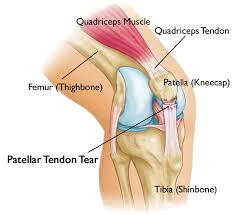
The patellar tendon is instrumental in allowing a person to straighten his/her leg. When the quadriceps contracts the force is transmitted through the quadriceps tendon and the patellar tendon, using the patella as a fulcrum and thus straightening the leg. If any link in this chain is disrupted- whether through a quadriceps tendon rupture or the patellar tendon rupture, a patella fracture or inability to contract the quadriceps muscle- the leg cannot extend at the knee. Keith Grennan of the Cleveland Browns, Cadillac Williams of the Tampa Bay Buccaneers, Kelenna Azubuike of the Golden State Warriors, and Correll Buckhalter of the Denver Broncos have all suffered from a patellar tendon rupture.

Are any athletes specifically at risk for a patellar tendon rupture?

A patellar tendon rupture tends to occur in people age 40 and younger. After the approximate age of 40 years, the quadriceps tendon becomes the more common tear in the extensor mechanism. Any condition that affects the quality or integrity of tendons or ligaments increases the risk of rupture; for example, diabetics and patients who take corticosteroids for an extended period of time for diseases like systemic lupus or rheumatoid arthritis. A growing population at risk is athletes that take anabolic steroids to increase their performance. Steroids can weaken the tendon and increase the risk of their rupture.


Symptoms

What are the symptoms of a patellar tendon rupture? How is it diagnosed?

An athlete that has a patellar tendon rupture has immediate pain and swelling in the knee. He or she will often say they felt a “rip” or “tear” sensation and will be unable to ambulate because of weakness and pain. On examination there are several tell-tale features in addition to pain and swelling in the knee. First, the athlete will be unable to actively straighten the leg. In addition, the examiner can usually palpate a defect in the tendon below the kneecap. However, in some cases the swelling in the knee joint (knee effusion) is severe enough that this is difficult to appreciate. The knee effusion in combination with severe pain with motion often requires radiologic examination to assist in making the diagnosis.

Are any imaging studies utilized in diagnosing the patellar tendon rupture?

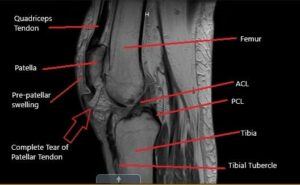
Knee X-rays are the first imaging studies that are obtained and can be very helpful. When the patellar tendon ruptures, the patella shifts superiorly because of muscle contraction of the quadriceps muscles. This shift in the patella position is called “patella alta.” X-rays also evaluate the knee for any other injuries that can present similarly to a patellar tendon rupture such as a fracture. If any doubt remains after physical examination and X-rays, an ultrasound or magnetic resonance imaging (MRI) can be performed.

Ultrasonography is a safe, inexpensive and rapid test that can detect a tendon tear. However, the test is technician dependent and in some facilities is not a reliable diagnostic test. MRI is also a safe test but is more expensive and takes longer to perform. In addition, availability of MRI’s can be limited in emergency rooms and a doctor’s office. However, an MRI can also evaluate any other potential problems in the knee such as ligament or cartilage injury. In the vast majority of athletes who have suffered a patellar tendon rupture, an MRI is not indicated as the diagnosis is made with X-rays and physical examination. However, in the case of partial tears, chronic tears or an unusual presentation, an MRI can be a useful diagnostic tool.


Causes


How does a patellar tendon rupture occur?

It is generally accepted that healthy, “normal” patellar tendons do not rupture. That is, there is an underlying degeneration in the tendon prior to complete rupture. The usual circumstance surrounding a patellar tendon rupture is when a person suddenly contracts the quadriceps muscle when the knee is in a flexed position. A common example is running up a flight of stairs or when a running back stops running quickly to change direction.


Treatment

How is the patellar tendon rupture treated in athletes?

For an athlete, surgical repair of the torn tendon is recommended. If the tear is treated nonoperatively, athletes rarely have the ability to extend the leg and ambulate normally without assistance. Surgical repair, while not an emergency, should be performed soon after the injury occurred. This allows for an easier repair before a significant accumulation of scar tissue. Most surgeons perform a direct repair of the tendon if it is torn in the middle. If the tendon is torn off of the bone, several different techniques can be utilized such as reattaching the tendon to the bone with a combination of sutures and bone tunnels. Regardless of technique, the goal of surgical repair is to re-approximate the tendon ends in a secure fashion to allow it to heal.

If the patellar tendon is not repaired soon after the injury (within 5-6 weeks), surgical repair can become more difficult and have suboptimal results. If the tendon cannot be repaired back to itself, a reconstruction can be performed with a graft from donor tissue (allograft) or tissue taken from another part of the patient’s body (autograft).

What is the usual recovery time and rehabilitation after a repair of the patellar tendon?

After surgery, athletes are placed in a knee brace that keeps their knee straight. Rehabilitation plans vary based on surgeon preference but most programs allow initiation of active knee flexion and passive extension by two weeks after surgery. At 6 weeks after surgery, athletes can walk without crutches. Usually, a return to athletic activities is delayed until 4-6 months after surgery based on leg strength and range of motion. The rehabilitation for chronic reconstructions is more substantial and prolonged than above.

What are the results of surgical repair?

If the repair is done acutely (within 3 weeks), most athletes report good or excellent results. Most athletes are able to return to their previous level of competition and do not report residual weakness or discomfort. The results with repairs done after 3 weeks are not as favorable because of persistent weakness or poor range of motion as the likely cause of disability.

Are there any complications associated with the surgery?

Loss of knee motion and quadriceps weakness are the two most common problems after surgery. Whether this is due to the initial injury or the surgical repair is difficult to determine, but likely due to the initial injury. With postoperative physical therapy as discussed above, the goal is to minimize these problems. Less common complications include persistent knee effusion, infection, and re-rupture of the repaired tendon.

If you suspect that you have a patellar tendon rupture, it is critical to seek the urgent consultation of a local sports injuries doctor for appropriate care. To locate a top doctor or physical therapist in your area, please visit our Find a Sports Medicine Doctor or Physical Therapist Near You section.

More Information

Read about sports injury treatment using the P.R.I.C.E. principle - Protection, Rest, Icing, Compression, Elevation.

Related Articles

Related Videos

Tibial Plateau Fracture Patellofemoral Pain Syndrome. Treatment and Recovery
Patellar Dislocation and Instability
Patellar Tendonitis – Jumpers Knee


References.

1. Siwek CW, Rao JP: Ruptures of the extensor mechanism of the knee joint. J Bone Joint Surg Am 1981; 63:932-937.
2. Larsen E, Lund PM: Ruptures of the extensor mechanism of the knee joint: Clinical results and patellofemoral articulation. Clin Orthop 1986; 213: 150-153.
3. Yu JS, Petersilge C, Sartoris DJ: MR imaging of injuries of the extensor mechanism of the knee. Radiographics 1994; 14: 541-551.
4. Ecker ML, Lotke PA, Glazer RM: Late reconstruction of the patellar tendon. J Bone Joint Surg Am 1979; 61:884-886.



This article has been read 18060 times


Comments


On 05/11 Brett McNamara said
Ruptured my left patella on 5/6/12 falling down stairs. Had surgery on 5/9. After surgery I felt great....felt ok yesterday! That all changed last night! Wow did the pain kick in!perocet and other drugs not touchin it! I highly recommend getting the ice water recirculator! It my only saving grace right now! Fortunately, I was able to borrow it from a friend! Im a firefighter, so I got a long battle to get back to work!...im gonna do it in 6months max....I hope! So much for golf this summer!
On 05/03 Welsh punjabi man said
For the last 6-8 years everytime I did any sprints or squatting my knees would be really painful for many days, even to the point I wouldn't be able to go upstairs. Went to the doctor he gave me anti inflammatory injection 'quarter zone' injection just underneath the right knee(which was always playing up) in feb 2012. I gave a rest to sports for around 4 weeks then started playing football again, on 28/04/12 as I was sprinting I originally thought I'd broken my leg and I was on floor with severe pain. Went straight to hospital hospital for X-rays, they put a brace on and told me it was pateller tendon rupture. I was given a date around 5 days later and yesterday on 2/5/12 I was surgically corrected for tendon rupture by the same doc that injected me with quaterzone injection 8 weeks earlier. as its the second day I'm in so much pain. Could the rupture be connected with the quaterzone injection? The doctor should have told me the side effects before injecting me with that!!
On 04/29 Dorothy Head said
I posted on this site on January 16th. 2012. I had my knee joint replaced on November 2nd. 2011 and then my patellar tendon ruptured 3 weeks later while I was doing my rehab exercises at home. Had surgery on December 5th. to repair or replace the tendon with a cadaver achilles tendon. Was in a cast for 8 weeks, and have been in a immobilizing brace for 12 weeks so far! Started physical therapy about 4 weeks ago and that is going well and I'm now able to bend my knee enough to get in my car and drive, it only took 5 months to get that far!! I still have to keep my leg straight when I weight bear and stand, so I am using a walker and some times a cane. MY PT says doctors are usually very conservative about the rehab on this surgery but it's OK! I really have learned to be patient and take one day at a time, no more crying!! I never want to hear and feel that popping sound I heard from my knee last year, ever again. I also still have a little bit of hesitation about pushing things in PT when it really hurts. The only thing I really hate is the restrictions as far as activity is concerned and the fact that I've gained weight, I feel like a slug!!! I have had cancer twice so I know that this could be a lot worse!! It will get better and I will get to do the things I used to all in good time. Oh and I'm 63 now!
On 04/01 Fonawah Atang said
On March 19th 2012 whilst playing football (soccer) I fell, heard a "snap" in my left knee with severe pain. I had dislocated my patella AND ruptured my patella tendon. It was surgically repaired the next day. I am currently in an above knee cast and on crutches. I hope to return to football. My consultant says 9-12 months hopefully.
On 03/27 Michael said
I ruptured my left patella tendon yesterday playing basketball. I went up for a layup and felt something pop while I was in the air. I'm having surgery on Thursday. Hope everything goes well. The doctor said I'm looking 6-9 months of recovery.
On 03/20 Mark Hamilton-Davies said
On February 14th 2012 I had a total right knee patella tendon Rupture, the cause of the injury was Ski binding not releasing . Surgery was performed 9-10 hours later in RUM Austria, Innsbruck. I am now at week 5 and have 120 degree Bend / Range of motion. I have been out of the brace for 1 week ( so week 4 ) I am training every day in the gym and performing light leg press twice per week ( 5-6 sets / 30 reps ) My Physio says the speed of recovery is very un-common, but I believe you get out what you put in....If you are willing to work then the results will come ...everyone who has had this Operation I wish you all the BEST for your speedy recovery - good luck MHD
On 02/26 Sean Mcdonnell said
I am a 43 year old male from the UK and suffered a complete tear of the patella tendon in May 2011. For whatever reason i was incorrectly diagnosed and waited nearly 3 months before surgery was completed. I am now 6 months post op and have achieved 110 degree bend and range of motion, consultant is very pleased with progress given the delay in surgery and build up of scar tissue. My advice is to work hard , remain positive and remember that someone is always worse off than yourself. This is a complicated injury from which to recover , keep the faith !!!
On 02/10 Zia Hasham said
I am 61 years old male. Last December 2011, on the first day of my retirement after 44 years of work, my right leg's pattellar tendon tore off after falling down only from 3 stairs. I had surgery next day and my broken tendon was reattached. It has been two months since the surgery and my leg still cannot bend more than 70 degrees even though I had rehab therapy every week. My quad are still week and I use a walker to walk. However, my doctor is very optimistic that I will gain 90% of use within 6 months.
On 01/16 Dorothy Head said
I am a 62 year old female and I had a total knee joint replacement on 11/2/11. Surgery was a success and I was rehabing well with little pain; I had home physical therapy. 3 weeks later while doing my home exercises in the evening I felt a pop accompanied by severe pain and my knee kept buckling. Went to ER, had X-rays and I was told it was probably scar tissue I heard pop. Went home and did gentle rehab exercises,till I felt the pain was not getting better. Called and saw my knee surgeon and had Xrays and I think he would have done surgery that day if he could! Had repair on 12/5/11. Now on 5th week of having cast on and no weight bearing. Was told I will have a brace that provided the same limitations when this cast come off, and will start rehab after that. Reading others experiences has helped me as I'm just learning that this is a very slow process. I have had little pain but the emotional part of being so helpless and loss of independence has been the worst experience so far. I had just retired at the end of September, so I'm hoping this will be just an unpleasant memory in a few months. I am longing to ride my beautiful new pink and white Trek road bike!! thank God for my wonderful husband, I owe him big time!
On 01/11 Al said
2 years ago playing basketball I rupture my right leg patella tendon after jumping for a rebound.. I felt a big snap and pop fell to the for floor like a sack, when I looked at my leg it look weird in the area of the knee and I had a big lump right under my hip. Come to find out it was my knee cap .. When it rupture it was like an elastic effect ...I started theraphy within a month,I was walking by week 5 with no crutches , by the 3rd month I was walking without the knee brace, and was running by the 6 month ... not fast kind of a limp run by the 8 month I was running at a pretty good speed by the 10 month I was playing basketball again. Not full speed but light jumping working on my side to side movement. I was playing full speed basketball by the year mark.... 2 years later here we go again I just ruptured my other patella tendon training ( working out) doing jumping drills it sucks I hope I goes a lot faster this time around due to this time happening to my left leg (weak leg). What r the odds of this ... I think my problem has to do with my IT bands ( the tightness) when I was doing my therapy, they told me that my IT band were really tight . And my inner thigh muscles were very weak. So the constant pulling of the knee to the outside must've weaken my patella tendon over the years... My goal this time is working my whole legs more often by doing plyometrics. I'll let u guys know my recovery with this one ....good luck !
On 12/31 Dennis Thompson said
I tore my patellar tendon playing a light game of basketball with one other individual.it's been 7 weeks now, and it was a unique tear.I have to keep my leg straight and I still don't have range of motion.Ithink this is the worst injury ever.After playing college football and having my knee scoped,this is hard to believe.
On 12/12 Nic (wales, UK) said
I totaled my left patella tendons falling off the back of my sons two wheeled scooter. 5 weeks of pain and hobbling around on 2 crutches post op. In the last 3 weeks however, I moved from 2 to 1 crutch to no crutches and now have even removed the leg brace. My knee is still swollen and bending is sore and limited, but progress comes little by little - so hang in there and be patient.
On 10/25 Jim Cahoon said
I am 60 years old and completely severed my right patellar tendon 8 weeks ago as a result of a fall from a ladder. I had surgery the very next day. Within 2 weeks I was walking about 3 miles a day stiff legged. I can now bend it 90 degrees and I walk about 5 miles a day. I do have to be real careful because I don't have the strength to support any weight while it is bent. I use a cane when I walk, mainly for balance. If I sit on a table with my leg over the side I can extend my leg but with much pain. I think that after just 8 weeks I am doing good, mainly because I do so much walking. I see the surgeon tomorrow and hopefully will start therapy soon. I cannot return to work until I pass a "fit for duty" test. Not sure what that all entales but I need to get back to work ASAP for my own sanity. I am a truck driver. I don't have to do very much physical labor, but sitting in one position for hours at a time may be difficult.
On 10/18 Kirk said
49 yr old male running 3rd rep of 40 yard sprints after a 40 min crosstraining exercise session. Felt & heard a painful popping sensation/sound in left knee & workout over! Can not bend knee without pain & still swollen 24 hrs later. Area just below knee cap primary area of pain. X-ray appeared normal waiting to see ortho dr. Any guesses as to what problem is?
On 09/01 Kevin said
I tore my left patellar tendon on 4/10/09 while performing a police duty. Due to conflict and discrepency with The City's health care provider, I didn't have surgery until 5/2/09. My physical theraphy was very extensive. My knee eventually wouldn't bend more than 70 degrees. I then had to have a procedure called a malnipulation to "break-up" the excessive scar tissue in my knee. With a lot of hard work during physical theraphy I was able to return to work (10 months later). Now, more than 2 years after my surgery I still have pain, discomfort and stiffness. I've continued to exercise my legs but the pain and stiffness seems to never go away. Is this a result of the scar tissue build up in my knee? Also, did the length of time it took for me to have surgery cause the scar tissue build up leading to my malnipulation procedure?
On 09/01 Lola said
I am a 25 year old female and I tore my right patellar tendon slipping on water in a tile bathroom directly on my knee while it was bent .. it was excrutiating pain and there was a huge not on the top where I fell. I went to the ER and got an xray and they diagnosed me then I had surgery 5 days later. I am 2 months since surgery and I started physical therapy 2 weeks ago. I can stand up now and am trying to bend the knee every physical therapy appointment. You have to do the exercises that they give you and heat the knee before trying to bend it ,, it will take a while but will eventually bend .... baby the knee dont do too much too soon so you dont rerupture it but go slow but persistent and i wish everyone good luck on the road to healing
On 12/28 Ross Richardson said
excellent information ! I am six weeks post op and have not started PT , will i be able to walk anytime soon
On 10/05 Vipul Chavda said
We are sports Rehab center from MUMBAI india. We have an excellent case.. Rt knee ACL insufficiency + Patellar tendon rupture (primary repair done). Post op x rays show poor patellar position i.e may elongated repaired PT. Interestingly patient is not UNSTABLE (even though ACL is not reconstructed). Have u come across such a case where poor PT repair helps knee from instability of ACL injury? What is the long term outcome? VIPUL CHAVDA www.prakrutihealth.com

Name

 
Email Address (Required)

 
Your Comment